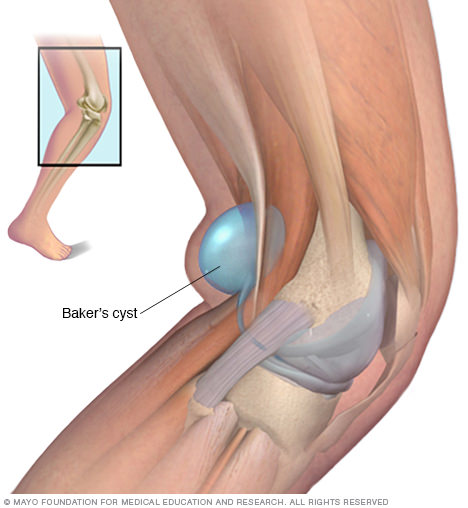
Baker’s cyst is a fluid-filled popliteal bursa located along the medial border of the popliteal fossa. It is an extension of the semimembranosus bursa posteriorly.
Symptoms associated with associated joint pathology (knee swelling or stiffness)
Pain in the popliteal space
Leg edema
Prominence of the popliteal fossa
Decreased range of motion of the knee
Locking of the knee
Foucher’s sign: the cyst becomes hard with knee extension and soft with knee flexion.
Neuropathic lancinating pains radiating from the knee down the back of the leg
Pain or discomfort with prolonged standing and hyperflexion of the knee
Presence of associated DVT
CAUSES
Believed to be fluid distention of bursal sac separating semimembranous tendon from medial head of gastrocnemius.
In children, popliteal cysts are usually a primary process arising from the gastrocnemius-semimembranosus bursa without direct communication with the joint space.
In adults, Baker’s cysts are usually associated with pathologic changes of the knee joint, such as the following:
Rheumatoid arthritis (RA)
Osteoarthritis of the knee
Meniscal tears
Patellofemoral chondromalacia
Fracture
Gout
Pseudogout
Infection (tuberculosis)
DIAGNOSIS
Baker’s cyst frequently mimics DVT and is sometimes referred to as pseudothrombophlebitis syndrome.
IMAGING STUDIES
Plain radiographs (AP and lateral views)
Ultrasound
MRI
MANAGEMENT
Rest
Strenuous activity avoidance
Knee immobilization sometimes necessary
NSAIDs can be used to treat underlying joint pathology (RA, gout, and pseudogout).
Arthrocentesis with intraarticular injection or injection of the cyst with corticosteroids (triamcinolone acetonide 40 mg).
Arthroscopic surgery to remove loose cartilaginous fragment
Partial or total meniscectomy
Open excision of the cyst
Talk to the Experts of MediSprint Physiotherapy
Let us help you on improving your joints and muscle activities for your daily functions.
Stop enduring the pain and stiffness in your body
Schedule a consultation to the registered professionals of MediSprint and assist you in achieving a pain-free life.